
0 ITEMS

Monthly Annuity Calculator

A monthly annuity calculator helps plan stable income streams during retirement and other financial goals.
- It provides an easy way to estimate monthly payouts based on investment amounts, interest rates, and time periods.
- Understanding how to calculate annuity payouts can help with retirement planning, insurance, mortgages, and loan management.
- The calculator uses formulas like the present value interest factor and Excel’s PMT function to streamline calculations.
- Knowing whether annuities are taxable and how to estimate payouts aids in making informed financial decisions.
Continue reading for practical tips on using a monthly annuity calculator effectively.
Effortlessly Calculate Annuity Payout Using a Monthly Annuity Calculator
Step-By-Step Instruction:
- Enter the Annuity Payment Amount.
- Input the annual interest rate..
- Set the number of periods. Indicate the total number of payment periods over the annuity's lifespan in months. For example, 5 years equals 5 x 12 = 60 months.
- Execute the calculation to calculate the Present Value Interest Factor and Monthly Annuity Payout.
A monthly annuity calculator primarily provides accurate estimations of regular payout amounts from an annuity investment over a specified period. Please note that our Monthly Annuity Calculator provides results rounded to the nearest whole number without decimal places.
What Is a Monthly Annuity?
Before defining a monthly annuity, let us first have an overview of what an annuity is. An annuity is a financial product that offers a series of payments made at equal intervals. There are three primary characteristics of an annuity:
- Constant Payment Amount: This refers to the uniformity of the payment amount in each period. The payments in an annuity are fixed and do not fluctuate throughout the contract, providing a predictable income stream. This consistency is particularly beneficial for individuals who require a stable and reliable source of income, such as retirees.
- Fixed Payment Interval: Annuities are characterized by their regular payment intervals, which could be monthly, quarterly, semi-annually, or annually. The interval is predetermined and fixed, meaning that the payments occur at regular, consistent intervals without any variations in the schedule.
- Guaranteed Payout: An annuity typically guarantees that payments will be made for either a fixed period or the recipient's lifetime. This guarantee is underpinned by the financial strength and reliability of the issuing institution, often an insurance company or a financial services firm.
Now, let us proceed with an overview of a monthly annuity. A monthly annuity, specifically, is an annuity with monthly payments. This type of annuity guarantees a steady stream of monthly income for the annuitant's life or a predefined term. The regular monthly payments offer financial stability and predictability, which is especially valuable for individuals in their post-retirement years, allowing them to plan their expenses and maintain their lifestyle with greater confidence. Monthly annuities are a common choice for retirement planning as they provide a consistent and reliable source of income, helping to alleviate the concern about financial security in later years.
What Is an Example of a Monthly Annuity?
Exploring the concept of a monthly annuity, we delve into its application within retirement funds and insurance, where it serves as a strategic financial tool to ensure a stable and predictable income stream post-retirement. They are the two most prominent examples of a monthly annuity.
- Insurance Annuities: A monthly annuity payment often provides a steady income stream to the policyholder in the insurance industry. This annuity type is designed to mitigate the risk of outliving one's savings, especially in post-retirement years. Upon purchasing a contract from an insurance company, the policyholder typically agrees to pay monthly annuity payments to the insurer. In return, the insurer commits to making periodic payments to the policyholder immediately or at a specified future date. These payments can be for life or a predetermined number of years. The monthly annuity payouts can vary based on several factors, including the length of the payment period, the initial investment amount, and whether the annuity is fixed (offering steady payouts) or variable (payouts tied to investment performance).
- Retirement Fund Annuities: Retirement fund annuities, on the other hand, are typically integrated into retirement plans. These annuities can be employer-sponsored, like a 401(k) in the United States, or individually set up through an IRA (Individual Retirement Account) or other retirement savings plans. In this context, the individual contributes monthly annuity payments to their retirement fund over their working years. Upon retirement, the accumulated savings in these funds can be converted into an annuity, ensuring a regular monthly income stream for the retiree.
In both cases, monthly annuities serve as a cornerstone for financial planning, offering a structured and reliable income stream that helps individuals manage financial risk and stability in different phases of life. Loans, mortgages, and rent are often considered monthly annuities despite not having a future payout in the traditional sense of an annuity due to the structure and characteristics of their payment schedules.
- Loans: Loans, especially amortizing loans like personal or auto loans, require fixed monthly payments. These payments typically include both principal and interest components. The monthly annuity payments are made over a specified period, after which the loan is fully paid.
- Mortgages: Mortgages are a type of loan specifically for purchasing real estate. Like other loans, they require regular, fixed payments over a period. Each monthly annuity payment includes a portion that goes towards paying off the principal amount borrowed and a portion that covers the interest on the loan.
- Rent: Rent typically involves a fixed payment made monthly for the use of a property. The rental agreement specifies the duration of the monthly annuity payment. For the tenant, rent represents a consistent cash outflow, much like a monthly annuity payment. However, unlike a traditional annuity, it does not build equity or return a lump sum at the end.
















































Are Annuity Payment Taxable?
Annuity payouts are considered as income for tax purposes. When you receive payments from an annuity, the portion that represents your initial investment (the principal) is typically not taxed because you already paid taxes before you invested it in the annuity. However, any earnings on the principal, such as interest or investment gains, are subject to income tax. The tax treatment of annuity payments can vary depending on the type of annuity, whether it's a deferred or immediate annuity, and whether the annuity was funded with pre-tax or after-tax dollars.
As for the taxation of annuity payments, the specifics can depend on various factors. Generally, if the annuity was purchased with after-tax funds, only the earnings portion of the payout is taxed as ordinary income. The entire payment is taxable as ordinary income for annuities purchased with pre-tax funds, such as those in a traditional IRA or 401(k) plan. It is because the contributions to these plans are tax-deferred, meaning you didn't pay taxes on the money when you initially invested it. It's also important to note that different rules may apply to annuities that are part of an employer-sponsored retirement plan or an IRA. Understanding these distinctions is crucial for accurate tax planning and compliance.
How Do You Calculate Annuity Payout?
Calculating annuity payouts is a crucial step in financial planning, offering a clear view of what to expect from your investments over time. You can calculate annuity payout based on your specific situation. The assumptions needed are as follows:
- The annuity payment amount or the sum of consistent monthly annuity payments made for a specified period.
- The interest rate or the annual percentage at which the invested fund grows.
- The number of periods covered (in our case, the number of months)
The formula to calculate annuity payout is:

Present Value Interest Factor for An Annuity
The present value interest factor for an annuity (PVIFA) is a formula used in finance to determine the present value of a series of annuities, given a specific interest rate and time period. The present value interest factor for an annuity can be calculated using the formula:

Where:
- r = the annual interest rate
- n = the number of periods
Sample Calculation
For instance, a $500,000 annuity payment amount with a 5% annual interest rate will pay a fixed monthly amount for 20 years (240 months). To calculate the annuity payout monthly, we can use the formula above.
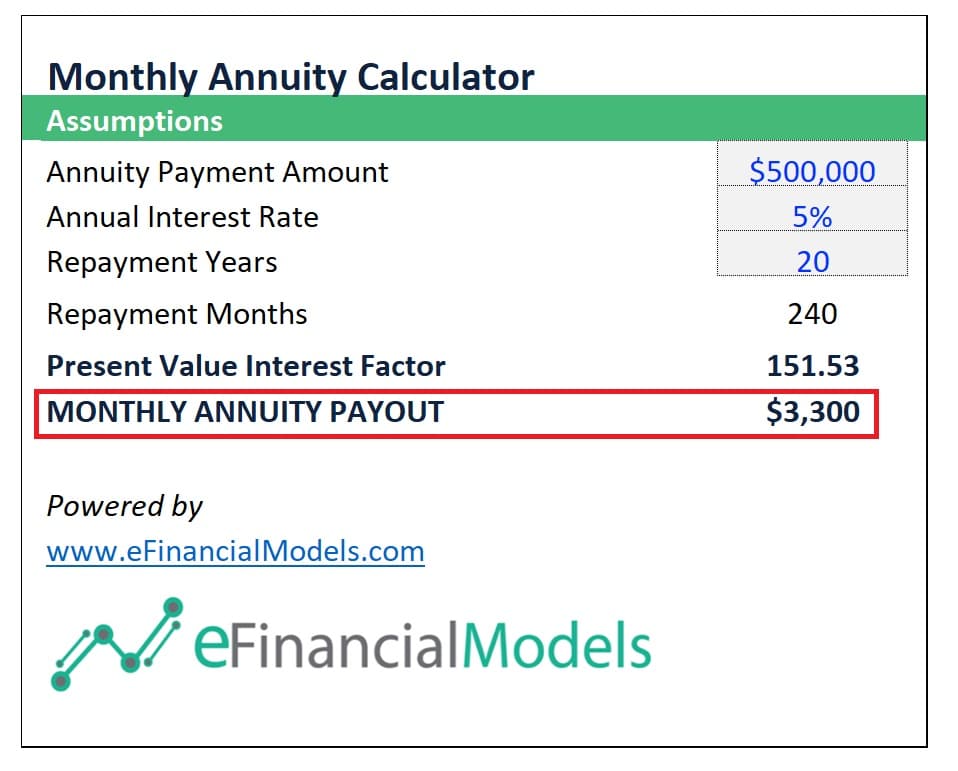
The present value interest factor for an annuity in the abovementioned situation is 151.53. Please note that we have divided the 5% annual interest rate by 12 during the calculation. It's essential to use a monthly interest rate to match the timing of these cash flows with the interest calculation. Multiplying the annuity payment amount of $500,000 to 1/151.53 means the monthly annuity payout for 25 years is $3,300.
Streamline Annuity Calculation Using the PMT Function
The PMT function in Excel significantly streamlines the calculation of annuities, providing a quick and efficient way to determine the periodic payment amount for a loan or investment based on constant payments and a constant interest rate. It's widely used in the financial industry to determine mortgage payments, car loans, and annuity payouts. This function is essential for financial planning and analysis, as it eliminates the need for complex manual calculations involving an annuity formula's present value.
By simply inputting the interest rate, the total number of payment periods, and the present value (or principal amount) of the loan or investment, Excel calculates the payment for each period. It saves time and reduces the potential for errors that can occur with manual calculations. Furthermore, the PMT function is versatile, allowing for adjustments in the calculation to account for different compounding periods and payment frequencies, making it an indispensable tool for financial professionals and individuals alike in managing loans, mortgages, and investment plans.
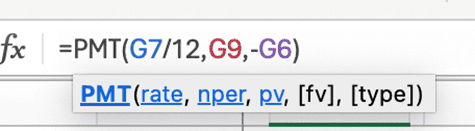
The structure for the PMT function is formulated as:
Where:
- rate: The interest rate per term; please note if you have monthly payments, you need to divide the annual interest rate by 12
- nper: The number of periods; if you have the number of years, but your payments are monthly, Then you need to multiply it by 12.
- pv: The present value of an annuity, entered with inverse sign (- instead of +). Typically, the PMT function returns a negative result. This is because the payment represents an outflow of cash. In our case, we want to show the PMT result as a positive number. To convert the PMT result to a positive number, we put a negative sign to the last value, the annuity payment amount.
- fv (optional): The future value or a cash balance you want to attain after the last payment. If omitted, it is assumed to be 0 (zero), meaning the loan's future value is 0.
- type (optional): The timing of the payment, either at the beginning (1) or the end (0) of each period. If not specified, it is automatically considered to be 0.
As we calculate the annuity value, we can use the PMT function in Excel to ensure accuracy.
Sample Calculation with PMT Check

Using the same assumptions, we used the PMT function, and it tallies with the result. The monthly annuity payout using the PMT function is also $3,300.
Why Use a Monthly Annuity Calculator?
A monthly annuity calculator is highly beneficial in various financial scenarios, particularly for those in insurance, retirement planning, loan management, mortgages, and rent calculations. These tools are essential for professionals and individuals who require precise and sophisticated financial planning and analysis. Both insurance providers and policyholders must understand the financial implications of such policies.
- For Insurance: In the insurance industry, a monthly annuity calculator determines the regular payouts from an annuity-based insurance product. For instance, when a client purchases a life annuity, this tool helps calculate the monthly income they can expect to receive.
- For Retirement Funds: Retirement planning is one of the most common applications of a monthly annuity calculator. It allows individuals and financial advisors to estimate the monthly income one can expect to receive from their retirement fund. This tool considers factors such as the total amount in the retirement fund, the expected rate of return, and the duration of the annuity. It's instrumental in helping retirees plan their finances and ensure a stable income stream post-retirement.
- For Loans: Loan officers and borrowers use monthly annuity calculators to determine the monthly repayment amounts for annuity-type loans. In such loans, the borrower repays the principal and interest in equal monthly installments over the loan term. This tool helps calculate these installments accurately, taking into account the loan amount, interest rate, and duration of the loan.
- For a Mortgage: Similar to loans, a monthly annuity calculator is vital in the mortgage industry. It assists potential homeowners in understanding their monthly mortgage payments. It is essential for budgeting and financial planning, as it clarifies the long-term financial commitment of purchasing a property.
- For Rents: A monthly annuity calculator can determine fair and sustainable rental prices in real estate and property management. It could benefit properties that are bought as an investment and rented out. The calculator can help determine the monthly rent needed to cover the mortgage payments or achieve a desired return on investment.
Easily Calculate Annuity Returns
In conclusion, utilizing a Monthly Annuity Calculator is invaluable to understanding and planning for future financial stability. By entering key details such as the annuity payment amount, interest rate, and the duration of the annuity, the calculator provides a clear, comprehensive projection of your annuity's performance. The tool demystifies the complexities associated with annuity calculations and empowers users to make informed, strategic decisions about their investments and retirement planning. Whether you are an entrepreneur, investor, or financial advisor, this calculator is crucial for ensuring a secure and prosperous financial future. monthly annuity payments





























You might also like:
- Monthly Annuity Calculator
- 10 Ideas to Increase Average Revenue Per User
- 10 Main Elements of a Business Plan
- 10 Tips to Develop a First Class Business Valuation Report
- 5 Best Practices for Managing Days Receivables
- Cash Flow Statement: Streamline Financial Success
- How to Calculate Net Present Value (NPV)?
- Personal Finance
- Financial Projections Templates – The Easy Way
- Financial Modeling using Excel
- Understanding Debt Sizing & Project Finance Ratios
- Understanding What is Yield to Maturity and Why It Matters
- Real Estate Financial Modeling in Excel
- Monthly Recurring Revenue (MRR)
- Financial Ratios Analysis and Its Importance
- Scenarios in Financial Modeling
- Income Statement
- Business Valuation
- Investment Proposal Template in Excel
- Monthly Budget Template (with Financial Statements)
- How to Use Excel for Financial Analysis?
Tags: Online Calculators